Politics
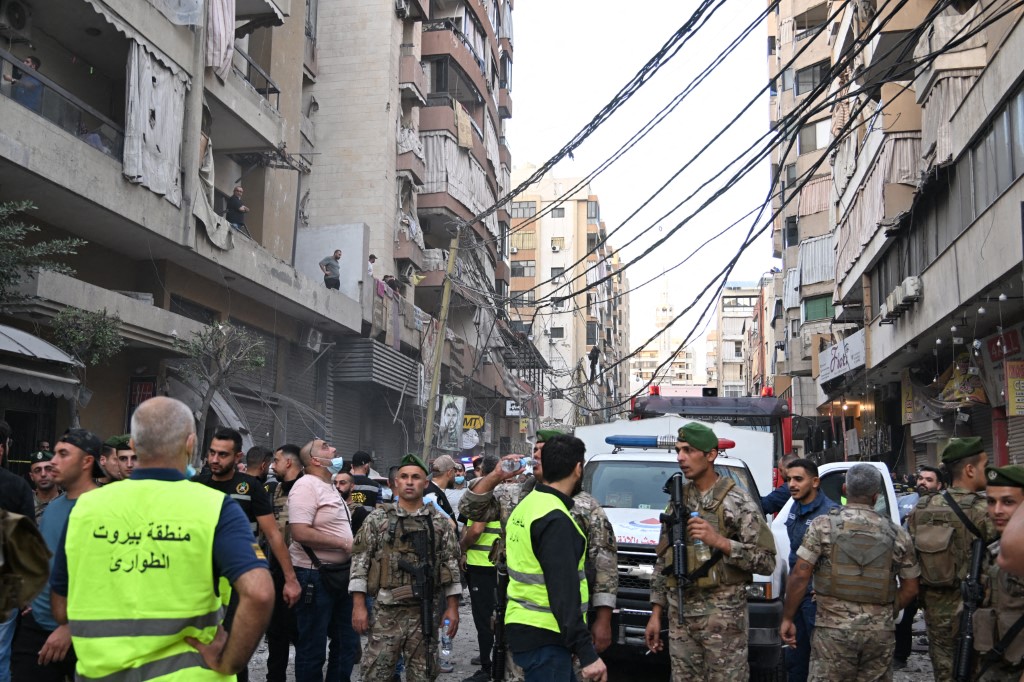




After Israel assassinated Hezbollah’s military commander Haitham Abu Ali Tabbataei, last Sunday, observers, experts, politicians, diplomats, and “strategic analysts” alike became consumed with predicting Iran and its party’s response: Will they retaliate? Will they refrain? Will there be no response at all?
Most of these observers doubted such a response would take place—either because Iran and the party continue to adopt what they call “strategic patience,” or because of their inability to match Israel’s militarily superior, technologically advanced, and intelligence-driven war machine.
Yet what is striking is that this noisy debate over the danger of the new phase facing Lebanon overshadowed—if not entirely obscured—three notable elements in President Joseph Aoun’s Independence Day speech from the city of Tyre: his five-point negotiation initiative, his remarks about two contradictory impressions within Lebanon, and his use of unusually blunt terms in official presidential rhetoric, most notably “the mini-state” and “denial.”
And while the presidential initiative and the new terminology have received their share of discussion in the media, on social platforms, and in political salons, the dual framework he presented—of two opposing mindsets among the Lebanese—requires scrutiny regarding its accuracy and realism, and whether it was introduced merely to create a sense of balance to soften criticism or resentment.
The first condition President Aoun devoted significant space to, was the “pride and denial” in which Hezbollah (without naming it) lives—a mindset in which the party behaves “as though nothing has changed, neither here nor around us nor in Palestine nor in the world… convincing itself that it can continue the same distortions in the concept of the state and its sovereignty over its land that have existed for forty years.”
In contrast, he referred to what he called “the other camp,” which he said holds the opposite impression—“that the earthquake that occurred wiped out an entire group in Lebanon, as though an entire sect had vanished or disappeared, or as though it no longer exists in the calculations of the nation, the charter, and the state.”
In truth, the president revealed nothing new in describing Hezbollah’s “pride and denial”; this depiction has been firmly established in public discourse since the ceasefire of November 27 last year—signed on the terms of the winner over the defeated.
What was new in the speech, however, was attributing to the camp opposed to Hezbollah’s weapons a stance that has never been substantiated—accusing it of believing in the disappearance of “an entire sect” (meaning, of course, the Shia community).
Does the president have any evidence, indications, or proof that “this definitive stance exists within this camp to erase the Shia from the nation’s, the charter’s, and the state’s calculations”?
To set the record straight, it is useful to review the statements and official positions of this “camp,” known as the “sovereign camp”—a bloc of parties, figures, and significant parliamentary and popular constituencies of diverse sects—none of whom have expressed anything resembling what the president suggested.
Indeed, these political and popular forces speak openly about Hezbollah’s military defeat as a result of the so-called “support war,” but they have never spoken of the defeat of the Shia sect “as a whole,” nor of its disappearance or erasure from Lebanon’s national and charter-based equation.
And if a few isolated and fleeting comments have appeared on social media in that direction, they are nothing more than verbal sparring between feuding individuals in the realm of virtual theatrics—they do not constitute a real phenomenon, nor a widespread “impression,” and they certainly cannot be used as a basis for a high-level state speech on a pivotal national occasion such as Independence Day.
The motive behind presenting this false equation may be an attempt to balance the party’s “denial” with a “second denial,” to dilute the impact of the first and absorb public discontent.
Such an equation belongs, in both form and substance, to the old-new logic of “six and six repeated,” where no member of one Lebanese side is held accountable, punished, or rewarded without searching for an equivalent case on the other side.
This constant search for a counterpart or parallel before making any decision or taking any position will, as always, lead to the paralysis of the state.
Can a state function by equating illegal weapons with political opposition to those weapons?
Those who oppose Hezbollah’s weapons clearly distinguish between the weapons and the community that surrounds the party; they do not hold an entire group responsible for the actions of some, nor do any of them wish for—or expect—the downfall of a Lebanese national component from Lebanon’s historically delicate and charter-based balance.
Any other claim of disappearance, elimination, or erasure is nothing more than a leak, an invention, or an assumption.
Please post your comments on:
comment@alsafanews.com